Somewhere in Moreton Bay right now, a business owner is looking at a website builder ad that promises a professional site for about the price of a couple of coffees a week. It looks great. It looks like gold. And sometimes, honestly, it is exactly what a business needs. But if you rely on Google to bring customers in from North Lakes, Redcliffe, Caboolture or across Brisbane, the sticker price is only a small part of the story.
We build WordPress websites for a living, so you’re entitled to be a bit sceptical about anything we say about the alternatives. That’s why this article shows all of its working. It’s the WordPress vs Wix vs Squarespace question for small business in Australia, answered with the real three-year cost, the things most comparisons leave out, and a straight answer on when a website builder is the smarter choice.
| THE SHORT ANSWER Wix and Squarespace are usually the cheapest way to get online, and a fine starting point for a new or referral-only business. WordPress costs more upfront, but it gives you ownership, more control over local SEO and a site that can grow with you. Over three years the cash gap is around $3,600 to $5,500. Whether that’s worth paying depends on how many enquiries your website needs to bring in from Google. |
How to Tell Fool’s Gold From the Real Thing
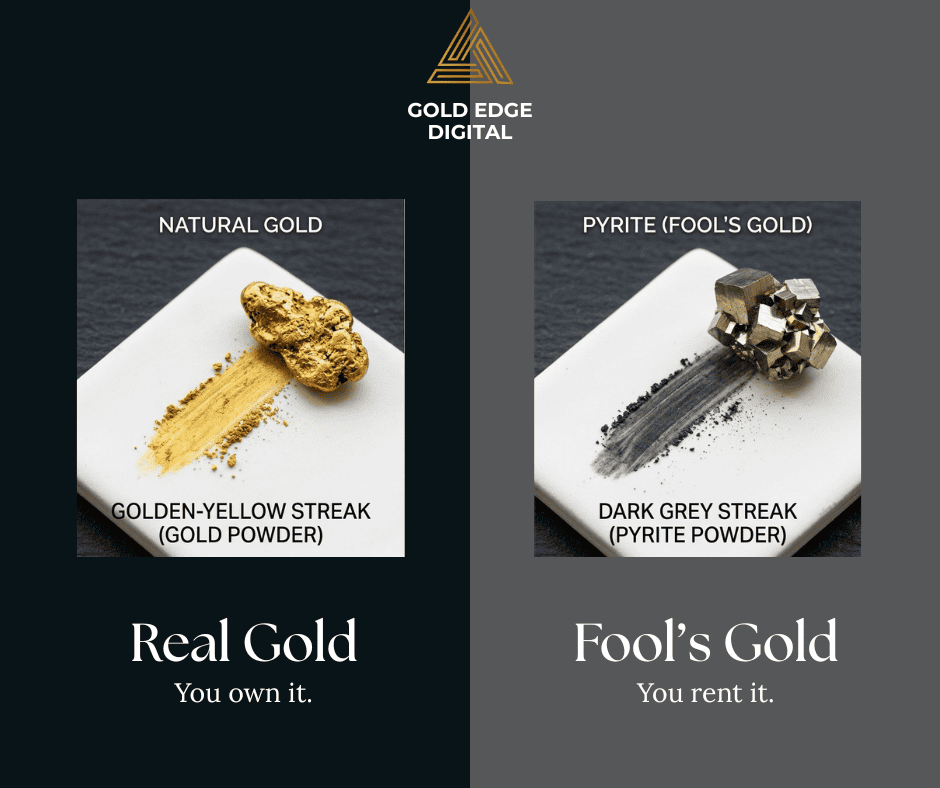
Pyrite, better known as fool’s gold, fools people for a reason. It’s shiny, it’s easy to find and from a distance it looks the part. Anyone who has done a geology field course learns three quick tests to tell it from the real thing. Real gold is soft enough to dent or cut with a pocketknife, while pyrite is hard and brittle and shatters. Gold leaves a golden-yellow streak when you rub it on unglazed tile, while pyrite leaves a greenish-black one. And gold is heavy, roughly four times denser than pyrite, so the imposter feels wrong in your hand.
“My first job was at one of the oldest gold mining operations in Benguet in the Philippines, so I had an early education in the difference between something that looks like gold and something that actually is.
The mineral pyrite, commonly known as ‘fool’s gold,’ is really impressive when you first see it. It is shiny, metallic and the kind of yellow that catches your eye and makes you think, ‘Oohhh, is this gold?’
But when you scratch it and see that the powdered form is gray, that’s the giveaway. Gold, in my experience, is either so subtle that it’s dispersed in gray quartz as very fine particles, or absolutely impressive as specks and wires that in no way you’d mistake for the blocky form of pyrite.
That lesson stayed with me. Sometimes something can look like gold at first glance without actually being the real thing. And sometimes the real thing doesn’t look particularly impressive until you know how to recognise it.”
-Liz
Websites work the same way. A builder site and a properly built WordPress site can look almost identical on launch day. The difference only shows up when you put them through a few simple tests, and those tests are how we’ll compare them: the weight test (how much work does it do for you?), the streak test (what do you actually own?) and the pressure test (what happens when things change?).
What Do Wix, Squarespace and WordPress Cost Over Three Years?
Most comparisons stop at the monthly fee. That’s the sticker price, and it’s only one piece. The real cost of a website over three years has four parts: the platform or hosting, the extras you’ll need to add, your own time, and the cost of fixing or moving it later. We’ll cover the first three here and the fourth in the pressure test.
Wix and Squarespace: the sticker price
Website builders bundle hosting, security and updates into one subscription. For a small business in Australia, plans typically land somewhere between $30 and $60 a month, depending on the plan, how you pay and whether a promotional price is running. Prices move often, so check the provider’s own pricing page before you decide. Squarespace, for one, lifted prices on some plans by up to 26% in July 2026, according to PetaPixel.
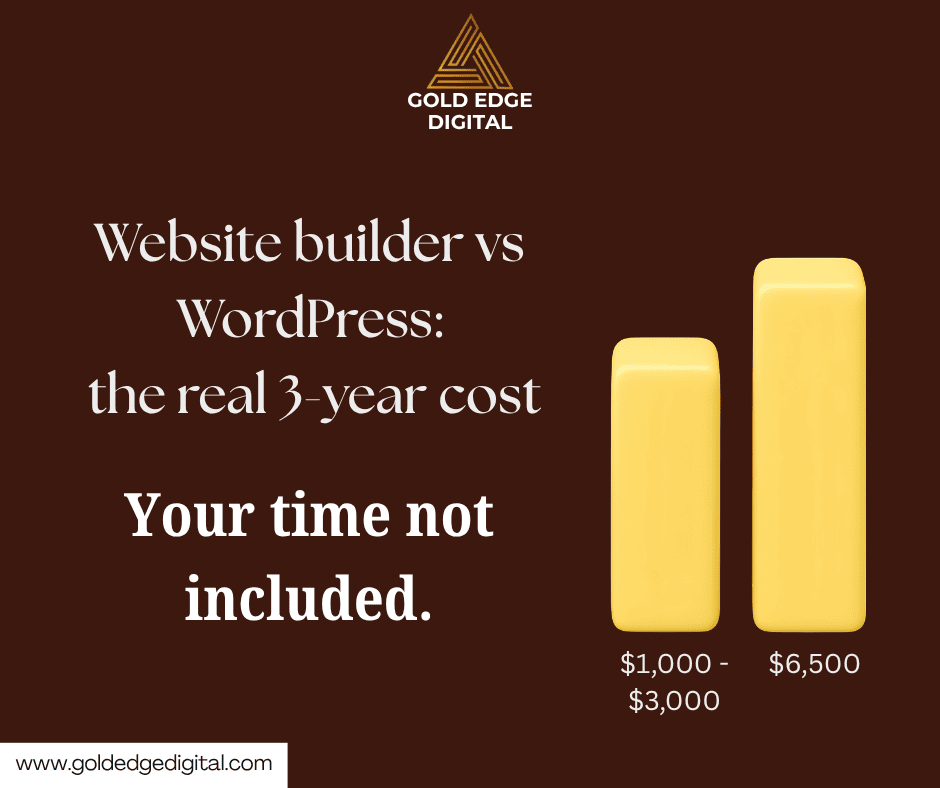
Over 36 months, that’s roughly $1,100 to $2,200 for the subscription. Add any paid extras for bookings, forms or email (up to about $20 a month) and a typical small-business builder site comes to around $1,100 to $3,000 in cash over three years. That assumes you build it yourself. We’ve left the domain name out of every figure, because it costs about the same on any platform.
WordPress with Gold Edge Digital
We can only speak with authority about our own numbers, so here they are. A Growth website (six to ten pages) is $2,999 as a one-off build. Website Care on the Essentials plan is $99 a month, which covers Australian hosting, domain management, software updates, backups and security monitoring. Over 36 months that’s $3,564 in care plus the build, for $6,563 in total.
That’s a mid-range example. A one-page Essential site is $999 and a Premium site with ten or more pages is $4,999, so your own number could sit above or below it. Other agencies price differently, so treat this as a benchmark for what a professionally built, professionally looked-after site costs.
The three-year side-by-side
| DIY on Wix or Squarespace | WordPress built and cared for by Gold Edge Digital (Growth) | |
| Build | $0 cash, but 30 to 50 hours of your time | $2,999 one-off |
| Hosting, security and updates (36 months) | $1,080 to $2,160 (plans of $30 to $60 a month) | $3,564 (Website Care Essentials at $99 a month) |
| Extras (bookings, forms, email, SEO tools) | $0 to $720 (up to $20 a month in add-ons) | Set up as part of the build |
| Cash cost over 3 years | About $1,100 to $3,000 | $6,563 |
| Your time | 30 to 50 hours to build, plus ongoing tinkering | A few hours to brief us and review the site |
| Total if you value your time at $60 an hour | About $2,900 to $6,000 | About $6,900 |
These are illustrative figures, not quotes. The 30 to 50 hours is our estimate for a first-time builder creating an eight-page site including copy and photos. Prices are in Australian dollars and were checked in September 2026.
On cash alone the builder wins, and we won’t pretend otherwise. But look at what happens when you count your own time. If you’re an electrician or a physio and your time is worth more than $60 an hour, forty hours spent fiddling with a website is forty hours you didn’t spend earning. The gap between the two options shrinks from around $3,600 to $5,500 down to roughly $900 to $4,000.
The Weight Test: How Much Work Does Your Website Actually Do?
Real gold is heavy. A website that’s doing real work is too: it brings in phone calls and form enquiries while you’re on a job site or with a client. So the most important number in this comparison isn’t the monthly fee. It’s how many enquiries the site brings in over three years.
Let’s be fair to the builders. Wix and Squarespace sites do rank on Google, and both have decent built-in SEO tools these days. The platform isn’t what decides your rankings. The work is: keyword research, well-structured pages for each service and suburb, fast loading and a steady flow of useful content. The real question is how much room you have to do that work. WordPress gives you more of it, with full control over page addresses and redirects, technical settings such as schema markup, page speed tuning, and thousands of plugins and specialists who know the platform inside out. On a builder you’re working inside someone else’s fences. It’s workable, but you’ll hit a fence eventually.
Here’s the maths on whether that extra room is worth paying for. Say a new customer is worth $1,500 to your business. A cash gap of $3,600 to $5,500 is paid back by three or four extra customers over three years, or roughly one every ten months. If your average job is worth $5,000, it’s one or two jobs. We can’t promise a WordPress site will deliver those customers, and nobody honest can. But it shows you what the website needs to do to justify itself, which is a much better question than “which one is cheapest?“
The Streak Test: What Do You Actually Own?
Rub real gold on a tile and it leaves a golden streak behind. Rub fool’s gold and you get a dull greenish-black smudge. The website version of the streak test is simple: if you stop paying, what’s left?
With a builder, you’re renting. Your site lives on the platform’s system, and if you leave you can usually export some of your content, such as blog posts and images, but not the working website itself. The design, layout and functionality stay behind. And the landlord sets the rent. Squarespace’s July 2026 increase of up to 26% on some plans reaches existing subscribers when they renew. That isn’t a criticism of Squarespace. It’s simply how renting works.
With WordPress, you own the files, the content and the domain. If you ever want to change hosts or agencies, you take your website with you. WordPress also powers more than four in ten websites, so there’s never a shortage of people who can help. Our Website Care plans are month-to-month with no lock-in, because we’d rather earn your business every month than trap you in a contract.
The Pressure Test: What Happens When You Outgrow It?
Gold is malleable. It takes pressure and holds its value, while fool’s gold cracks. In website terms, the pressure arrives when your business grows. You need a booking system that fits how you actually work, a page for each suburb you serve, or a faster site because your competitors’ pages load quicker than yours.
On a builder, those upgrades often mean paid add-ons, awkward workarounds or a developer who has to work within the platform’s limits. Sometimes there’s simply no way to do what you want. And when you finally decide to move, migration is essentially a rebuild. Your content has to be transferred, your design recreated, and every old page address redirected to its new home so the rankings you’ve earned don’t vanish. Done properly, a move doesn’t have to hurt your search visibility. Done in a hurry, it can wipe out months of progress.
It’s a common story: a business starts on a builder to get online quickly, does well, then pays for a proper build a couple of years later. If you already know that’s the path you’re on, it’s worth asking if you can skip the middle step. Our articles on website renovation or new build and the hidden costs of cheap hosting go deeper on both sides of that decision.
When a Website Builder Is the Right Call
Sometimes the shiny option is the right option. If you’re a brand-new business on a tight budget and you need something live this week, a builder is a perfectly good first claim. The same goes if all your work comes through referrals and your website is basically a digital business card, or if you’re testing an idea before you commit to it.
If that’s you, go for it, and make it easy on your future self. Register your domain name in your own account rather than through the builder. Keep your written content and photos in your own files. Keep a list of your page addresses. And set a reminder to review things in 12 to 18 months, when the business is established and you know what the website really needs to do.
Three Questions to Decide for Yourself
Here’s a quick test you can run in five minutes. Be honest with your answers.
- Does your website need to bring in enquiries from Google? If most of your new customers search online for someone like you, WordPress gives you more room to compete.
- Will you invest in local SEO in the next 12 months? Local SEO works on any platform, but it works best when nothing stands between your plans and your website.
- Do you want to own your website outright? No platform dependency and no surprise rent increases. That’s WordPress.
If you answered yes to two or three, WordPress is probably the better long-term investment. If you answered no to all three, a builder might be all you need right now.

What This Means for Brisbane and Moreton Bay Businesses
Local competition is where the platform question gets real. Someone searching for “plumber Narangba” or “physio Redcliffe” is ready to call, and the businesses that show up are usually the ones with a page for that service and that suburb, a well-kept Google Business Profile and a site that loads fast on a phone. Building that kind of local footprint is straightforward on WordPress, where you can add a new service or suburb page with the titles, headings and schema markup set exactly the way you want them.
That’s why every website we build starts with keyword and competitor research before a single page is designed, and why our clients own their sites outright. If you’d like to see how a WordPress website could fit your business, have a look at our web design packages, read how local SEO starts with a solid website, or see what’s included in our Website Care plans.
Frequently Asked Questions
Is WordPress better than Wix for SEO?
WordPress gives you more control over the technical side of SEO, such as page addresses, redirects, schema markup and page speed, and it has a huge range of specialist tools and people who know it well. Wix sites can and do rank on Google, though. The platform matters less than the quality of the work done on the site, which is why a well-optimised builder site can outrank a neglected WordPress one.
How much does a WordPress website cost in Brisbane?
It depends on the agency and the size of the site. At Gold Edge Digital, a one-page site is $999, a six to ten page site is $2,999 and a site with ten or more pages is $4,999, all one-off prices. Website Care, which covers hosting, updates, backups and security, starts at $99 a month with no lock-in.
Is Wix or Squarespace cheaper than WordPress?
In cash terms, yes, especially if you build the site yourself. Over three years a DIY builder site typically costs around $1,100 to $3,000, compared with around $6,500 for a professionally built WordPress site with ongoing care. The gap narrows once you count your own time, and it can be paid back quickly if the website brings in a few extra customers.
Can I move from Wix or Squarespace to WordPress without losing my Google rankings?
Yes, if it’s done carefully. The key is to redirect every old page address to its new equivalent, keep your important page titles and content, and check that Google can crawl the new site. A rushed move without redirects is where rankings get lost.
Do I have to pay monthly for a WordPress website?
Your website has to be hosted somewhere, and it needs regular updates and security monitoring to stay safe. You can arrange that separately, but most of our clients choose a Website Care plan, which bundles it together from $99 a month. It’s month-to-month, so you can cancel any time.
Which is best for a tradie or health provider: WordPress, Wix or Squarespace?
If your business relies on local search and you’d like to grow enquiries over time, WordPress gives you the most room. If you’re just starting out or work entirely on referrals, a builder can be a sensible first step. A free chat can help you work out which side of that line you’re on.
Ready to Find Out Which Is the Real Thing for Your Business?
Choosing a platform isn’t really about WordPress, Wix or Squarespace. It’s about what you want your website to do for your business over the next three years, and how much of it you want to own. Getting that right early saves a lot of money and a lot of rework.
Want to know which platform is right for your Brisbane or Moreton Bay business right now? Book a free chat with Liz. We’ll look at where you are and where you want to go, and give you an honest recommendation, even if that recommendation is “stay on Wix for now”. No pitch, no pressure, no obligation.
Not ready to chat yet? Try our free Local Business Visibility Scorecard to see how your website and Google presence stack up.